
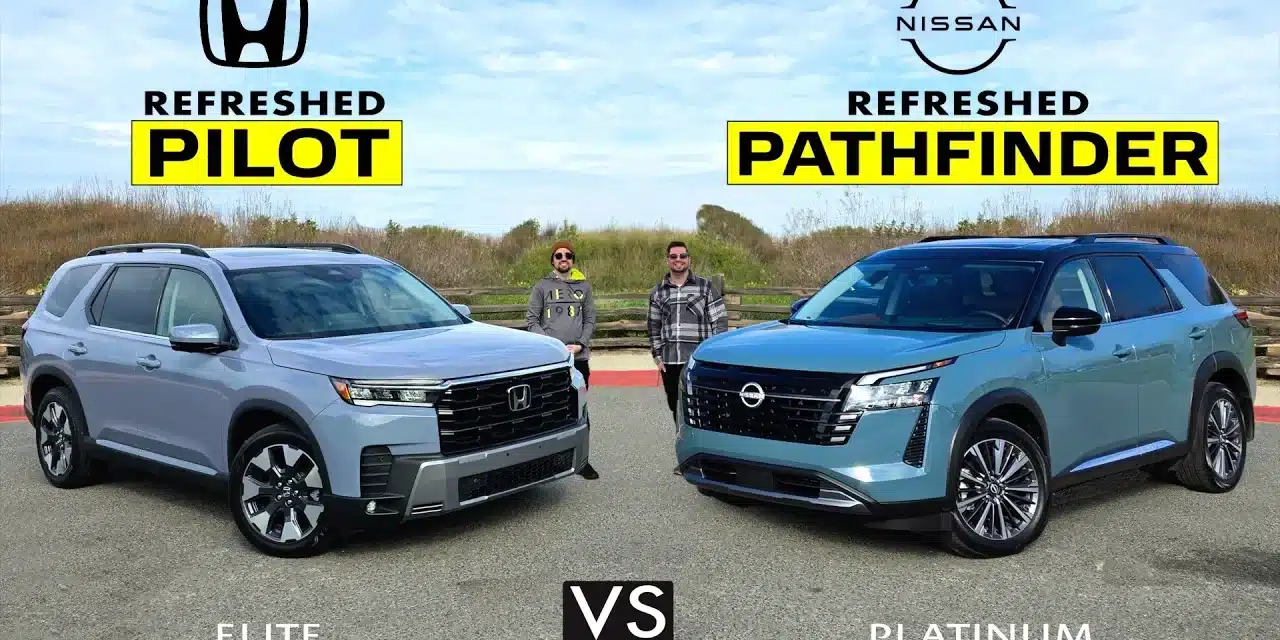
There are a ton of family SUVs on the market nowadays, which means you have more variety than ever before. But many still crave the tried-and-true formula, which is something the refreshed Honda Pilot and refreshed Nissan Pathfinder stick to pretty well. One of the key things is that they both come with V-6’s; something now rare in this class. But with both SUV’s rocking lots of design, tech, and luxury enhancements this year, who is the best pick for you in a 2026 Nissan Pathfinder vs. 2026 Honda Pilot comparison? Let’s find out!


Exterior Design
Starting with the exterior designs, both models have gotten some tweaks for 2026, primarily to look more squared off and tougher. For the Pilot, that means a boxier, larger grille with a new scuff plate accent this year, finished in silver for the Elite trim. The Pathfinder also has a wider appearance for its refresh, with the Platinum trim sporting lots of gloss black on the grille and some silver accents for a luxurious touch.
But, let’s look at the lighting. Both models have reflector LED headlights with a slim design. The Pilot has some advantages here, though, with all its lighting elements LED, including the turn signals. That’s in addition to having LED fog lamps, which are missing from the Nissan.
Moving to the side, the Pilot has about a 3-inch length advantage over the Pathfinder, as it is one of the largest in the segment, but we will be checking out the interior space later. As you can see, both have substantial and boxy designs with raised roof rails and 20-inch contrast alloy wheels, while only the Nissan offers the premium option of a tow-tone paint job.
Length: 200.1-inches (Pilot) | 197.7-inches (Pathfinder)
Out back, the boxiness continues, with much fewer changes than up in the front. For features, they are very similar with spoilers, exposed wipers, and large branding between the taillights. Additionally, they both have partially LED taillamps, with only the brake lights and accenting being LED.
The Pathfinder, though, has a 1,000 lb maximum towing advantage over the Pilot.
Towing (max): Pathfinder: 6,000 lbs | Pilot: 5,000 lbs
When it comes to the mirrors, both have heating, blind spot monitoring, and power-folding. But only the Honda has premium auto-dimming ability, as well.
Continuing with safety, both models have their brands’ entire suite of systems as standard equipment, to keep your family safe on the day-to-day.
Now, these SUV’s have had some big changes on the inside, so let’s check those out.
Interior Design
Approaching the cabins, both have their brand’s typical key fobs, equipped with smart entry systems and remote start on the fob.
Opening the doors, both cabins are more luxurious than ever for 2026, and that starts with the seating.
While both models have nice looking seats, it’s the Pathfinder that will have the materials advantage, with full semi-analine leather seats, which is higher quality than the regular leather on the Pilot Elite. Both have unique quilting designs, and the seats themselves will be equipped with heating, ventilation, memory, and 12-ways of adjustment.
Hopping in, we can get into the cabin materials, which we divide into both material choice and overall build quality. Both are very solid when it comes to the build quality, with everything fitting together without gaps. And, while they both use soft touch materials, leatherette wrapping, and faux wood trim throughout, it’s the Nissan that uses more of it, even wrapping the center tunnel for knee comfort. It will receive the materials point.
After startup, you’ll see digital gauge clusters on both with lots of customization, though the Pathfinder’s is a couple inches larger. These top models also come equipped with head-up displays for even more convenience.
Pulling back, they share rain-sensing wipers and heated, leather-wrapped steering wheels. But, the Nissan has the premium addition of Power Adjustment as well.
Storage and Technology
When it comes to the next important category of storage, we evaluate both the center consoles and extra cubbies offered. Since the console sizes haven’t changed with the refreshes, we can confirm the Pilot’s is bigger, fitting 23 of our signature donuts as compared to 16 in the Pathfinder. Beyond the consoles, they both have many other cubbies, including a passthrough for the Pathfinder, and passenger storage shelve on the Pilot to store away whatever you need.
In the front cubbies are wireless chargers, but the Nissan’s is the newest Qi2 charger, one of the first models in the US to offer this with better performance and MagSafe in a vehicle.
Both have electronic shifters, and in reverse, both display 360-degree cameras with good resolution.
For climate, they both have 3-zone automatic climate controls, with easy-to-use physical knobs and buttons.
They also share physical volume knobs to sample the Bose sound systems.
Pilot: 12-speaker Bose Premium sound system
Pathfinder: 13-speaker Bose Premium Sound System
With only a one-speaker difference and hailing from the same brand, sound quality is almost identical.
Now, both have had the biggest change in the screen department this year! Both the Pilot and Pathfinder are sporting new 12.3-inch displays now, an answered prayer for many admirers of these models. Software-wise, both see big improvements, adding things like Google Maps, and they have wireless AA, wireless ACP, and other Google apps built in. The Pilot also has the handy CabinTalk feature to make sure the kiddos in the back can hear what you say.
Wrapping up the front of the cabins, both have auto-dimming rearview mirrors with HomeLink remotes and large panoramic roofs.
LOOKING TO BUY One OF THEse VEHICLES?
A smart next step would be to check our Car Quote Tool. This tool will connect you with local dealerships in your area to get you the BEST price, access to INVOICE PRICING information, and a monthly payment calculator. Get dealerships to compete for your business!
Rear Seats and Cargo
Now let’s see how the packaging plays out in the rear seats! Starting in the second row, we see the Pilot pull ahead on space, with an impressive lead of about 5 inches in legroom and about 1-inch extra headroom as well, though that aspect is less than the 5% difference required to score a point.
- Pathfinder: Legroom: 35.5-inches | Headroom: 38.4-inches
- Pilot: Legroom: 40.8-inches | Headroom: 39.2-inches
But things even out a lot more when it comes to the features. They both include heating, sliding, and reclining seats with sunshades, USB ports, and rear climate controls for these top trims. However, the Pilot sneaks in a household outlet as well for extra charging needs.
Additionally, the Pilot has a seating trick up its sleeve. While the Pathfinder can only have a bench seat or captain’s chairs, the Pilot can do both! It has a removable seat that also serves as a console. This allows for on-demand 7 or 8-passenger seating, something the Nissan cannot do.
Now let’s check out the third-row space and features. Before getting back into the seats, entering is more convenient with the Pathfinder, as its second-row seats tilt without moving the seatback, meaning you would not have to remove many child seats.
Now for the measurements, where headroom is similar, but the Pilot once again has a legroom advantage. The Honda has a much more comfortable and spacious 3rd row, since the Pathfinder is one of the smallest in the segment. Features-wise, each model has at least one USB port, some cupholders, and air vents.
- Pathfinder: Legroom: 28.0-in | Headroom: 37.8-in
- Pilot: Legroom: 32.5-in | Headroom: 39.3-in
Walking up to the tailgates, both have hands-free power ones, and once they open up, the Pilot continues to have a space advantage. It still beats the Pathfinder in all 3 seating configurations, behind the 3rd row, behind the 2nd row and behind the 1st row. This makes it more family-friendly for hauling everything you need along.
Pathfinder: Behind 3rd row: 16.6 cu.ft | Behind 2nd row: 45.0 cu.ft | MAX: 80.5 cu.ft
Pilot: Behind 3rd row: 18.6 cu.ft | Behind 2nd row: 48.5 cu.ft | MAX: 87.0 cu.ft
Beyond space, neither have power third rows nor handles to fold the 2nd row from the cargo areas. But you will find spare tires underneath the floors.
That’s it for the interiors, so now let’s take this fight to the streets!
Powertrains
As we said in the beginning, these two models have long been known for their hearty V6 powertrains, and that continues for both in 2026. They have tried and true 3.5L V6 engines, with almost identical power and torque figures, as well as overall acceleration. This is accompanied by refined, throaty exhausts.
- Pathfinder: 3.5L V6: 284 hp | 259 lb.ft | 0-60 in 7.0s
- Pilot: 3.5L V6: 285 hp | 262 lb.ft of torque | 0-60 in 7.2s
As far as the other elements, the Pathfinder has a 9-speed automatic transmission, compared to 10 in the Honda. While advancements have been made to both transmissions over the years, we find the Pilot’s to be a bit more agreeable in everyday use, compared to the Pathfinder’s which is more prone to the occasional confused shift.
Both have capable AWD systems as equipped and dedicated off-road trims available.
Test Drive and Fuel Economy
But, how do these two fare when it comes to ride quality and handling? For the important trait of ride quality, both the Pathfinder and Pilot are segment leaders, riding incredibly smoothly on most any road, especially when combined with the comfortable seats! After many hours of driving both models, we were very happy with both.
However, on the handling front, the Pilot is more agile, with less body roll and more accurate steering than the Pathfinder.
Let’s also talk about the dB readings. Unfortunately, we took both sound level readings while we were sampling them at press events, so we can’t officially score these 55 MPH readings yet. We’re excited to live with both of them back home in Kentucky, but here are the readings for your reference in the meantime.
Pathfinder: 56.3 dB @ 55 MPH
Pilot: 55.5 dB @ 55 MPH
Finally, for fuel economy, neither lead the segment, especially since several rivals offer hybrids at this point. The Nissan slightly edges out the Honda, but not by enough to score a point.
- Path AWD: 20/25/22 MPG
- Pilot AWD: 19/25/21 MPG
Resale & Reliability
In our reviews and comparisons, we are also adding in reliability and resale information to give you a better picture of the overall value beyond just the original MSRP.
Beginning with reliability, we developed the Combined Reliability Index, which takes into account several studies from trustworthy sources, and combines them in a way that gives a more realistic picture. In this respect, Honda is one of the best in the business, rated 12 spots above industry average. Nissan is also above average, but less than Honda, as it is rated 9 spots above the industry average.
Related to that, they have the same warranty coverage, but Honda has one year of complimentary maintenance compared to Nissan’s two.
Pilot: Warranty: Basic Warranty: 3yr/36k mi | Powertrain: 5yr/60k mi | Comp Main: 1 yr
Path: Warranty: Basic Warranty: 3yr/36k mi | Powertrain: 5yr/60k mi | Comp Main: 2 yrs
We also put Mason’s economics degree to work to develop a detailed Predicted Resale Value tool. After 5 years and 60,000 miles, Honda actually has the highest value in the entire auto industry, at 64.79% expected retained value. Nissan is further behind at 50.56% after 5 years and 60,000 miles.
And if you’d like to check out all our data about reliability and resale values, as well as learn about our methodology, make sure to head to carconfections.com/resale and /reliability. Buying a car is a big decision, and this is a great place to compare all the makes you might be cross-shopping.
Price Assessment
Now let’s talk about pricing.
In a very expensive segment, both the Pilot and Pathfinder represent more value than most of their competitors, but they’re still not cheap in top trims. The Nissan leads the charge at $54,445, and the Pilot is exactly 1 grand more expensive.
Pathfinder (Platinum AWD): $51,400 | Options: +$1,550 | Destination: $1,495 | Total: $54,445
Pilot (Elite AWD): $53,495 | Options: +$455 | Destination: $1,495 | Total: $55,445
2026 Nissan Pathfinder vs. 2026 Honda Pilot Winner!
So, there you have it! Do you agree? Here are a couple of things to consider when picking each one for you personally:
Pilot:
- More cargo and passenger space
- Flexible rear seating
- Best resale and Reliability
Pathfinder:
- Nicer materials in cabin
- Less Expensive
- Longer Complimentary Maintenance
Now we want to know your opinions, so make sure to head to the comment section and let us know which one you would pick!
Thanks for joining us for another Car Confections Comparison! We’ll catch you next time as we sample the latest automotive delicacies!










Recent Comments