

With new car prices rising so quickly in the US nowadays, it is refreshing to see manufacturers that try to provide value-packed models. And two SUV’s that certainly fit that mold are the Hyundai Santa Fe and Kia Sorento. These SUV’s have been very popular for that reason, and while they are somewhat related to one another, there are tons of differences between them, which is why we are comparing them today. So, who is the best pick for you in a 2026 Hyundai Santa Fe vs. Kia Sorento comparison? Let’s find out!




Exterior Design
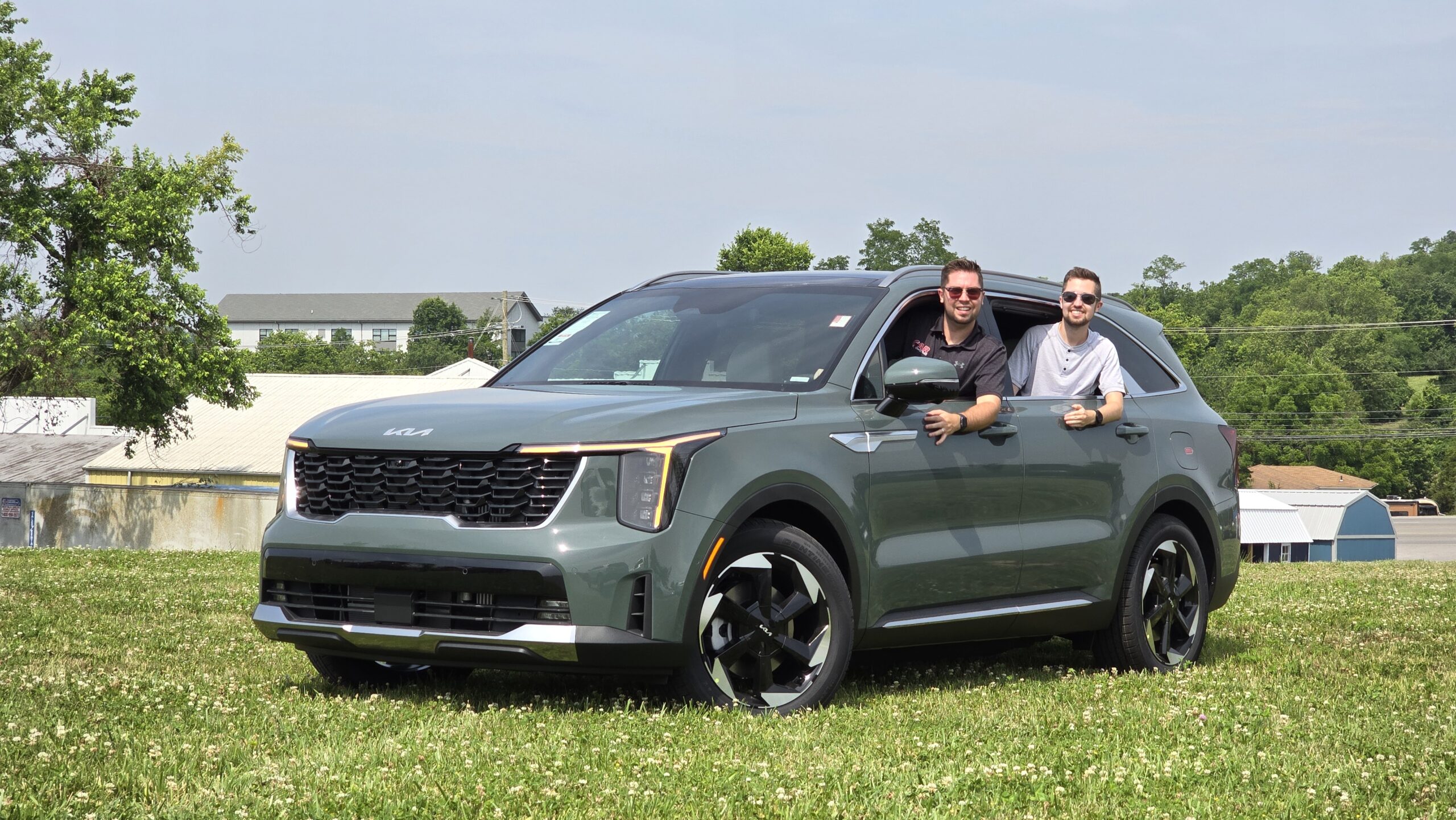
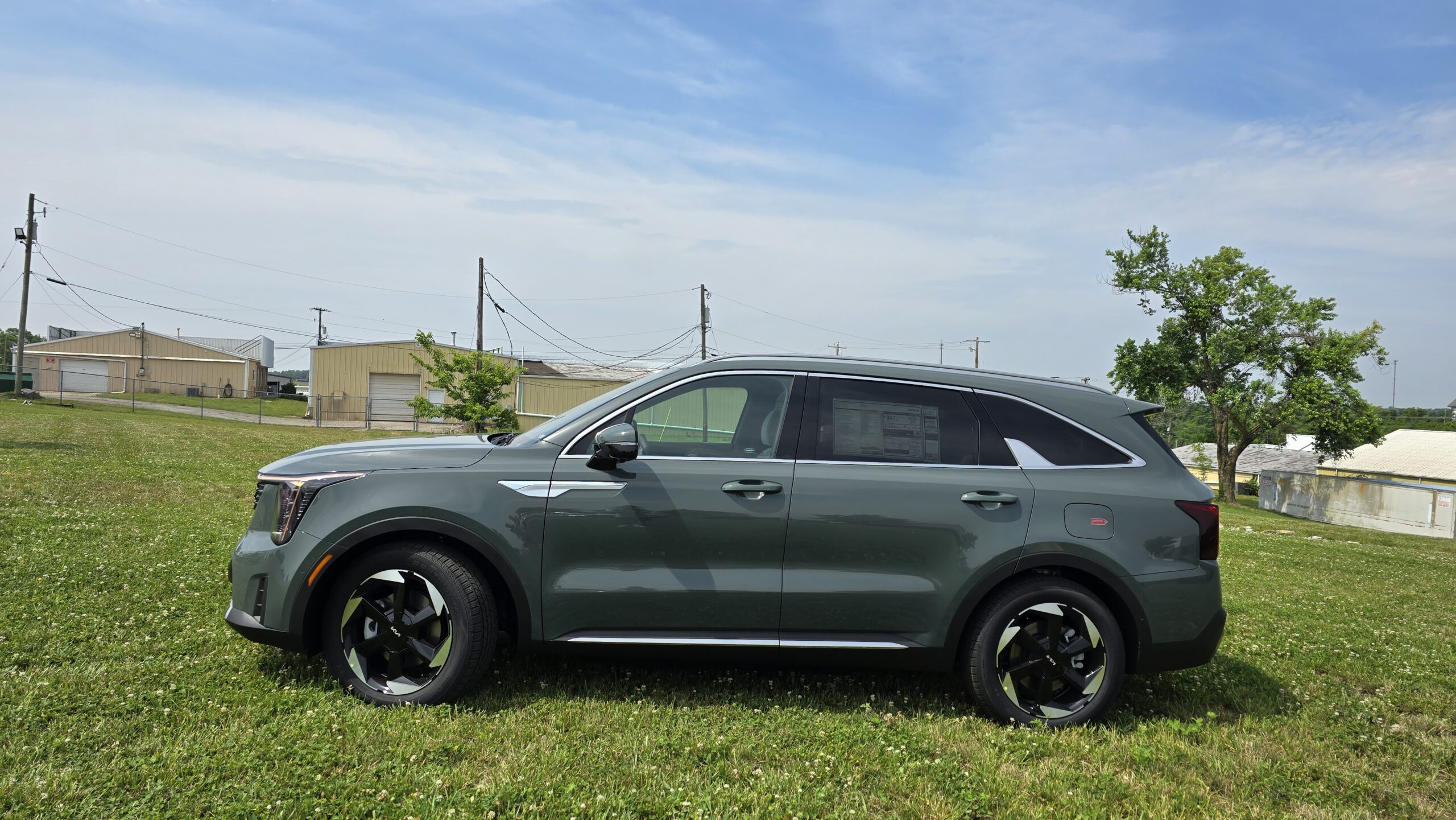
So, starting with the exteriors, boldness is the name of the game for these Korean SUVs! The newest Santa Fe is recognizable in name only, as it has transitioned to a fully boxy design, dividing many accustomed to the previous smoother look. As for the Kia Sorento, it also has a bold design, with the brand’s latest “Opposites United” design scheme.
Now, let’s start with the lighting. Each features projector LED headlights and bold daytime running light shapes. But one difference to note is that only the Sorento will have fog lamps.
Conversely, the Santa Fe has a 20-inch wheel, as compared to 19-inchers on the Sorento.
Another inch difference between them is the length, where the Santa Fe just barely edges out the Sorento. We will talk more about the interior packaging later, but as far as exterior concerns, the Santa Fe also adds a cool handle to help you access items on the roof.
Length: 190.2-in (Santa Fe) | 189.0-in (Sorento)
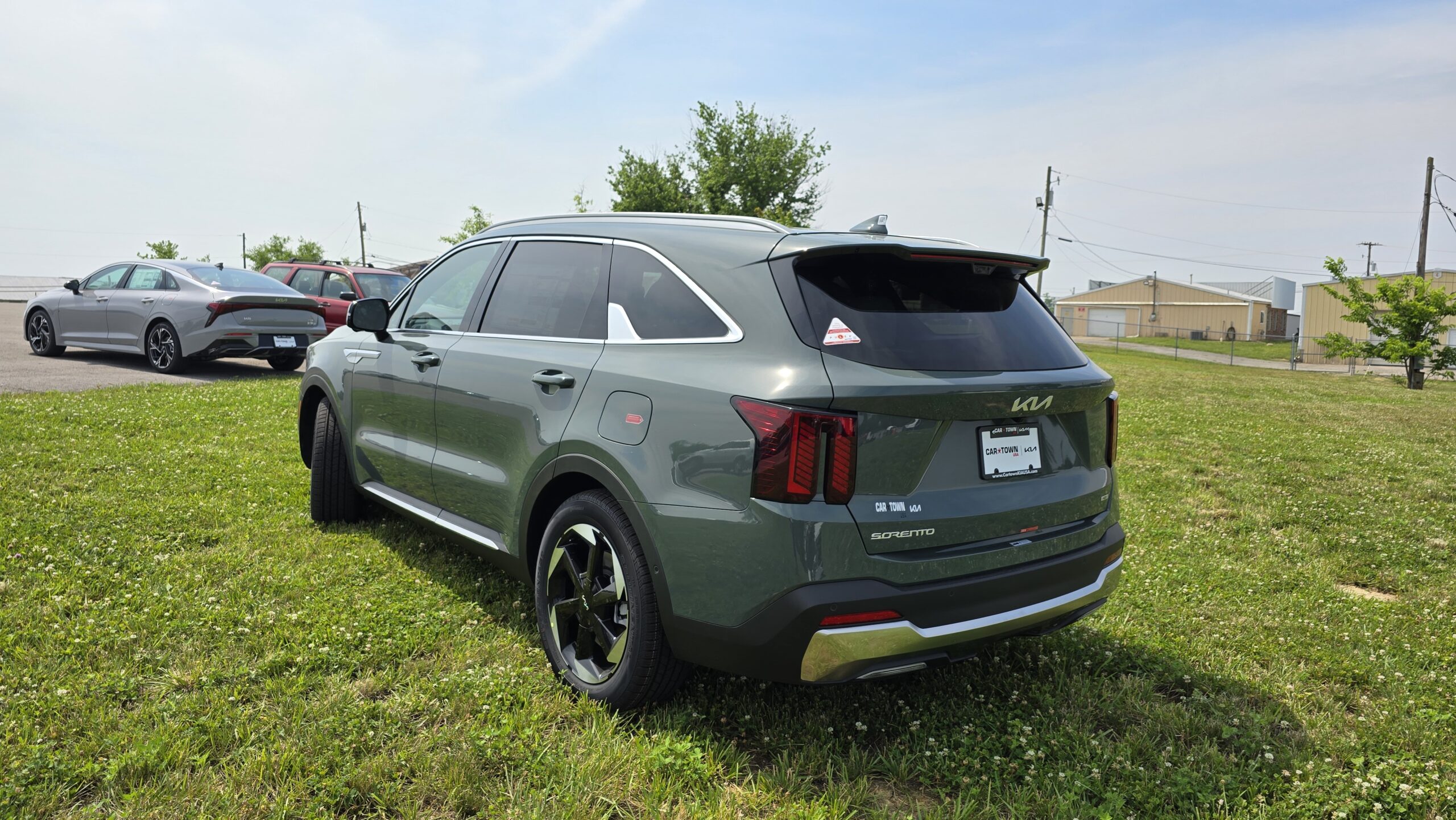
Heading to the controversially designed rears, the features are straightforward. Both features hidden rear wipers, partially LED taillamps, and, as equipped, they can tow 2,000 lbs.
At the mirrors, they continue to match each other with heating, blind-spot monitoring, and power folding. Additionally, each feature an extensive safety suite with all the major systems, including Highway Drive Assist 2.0, a highway assistant with auto lane changing, which reduces road trip fatigue. However, the Santa Fe adds the special touch of Smart Park, to pull in and out of spaces remotely.
The luxury continues as we head to the comfy and tech-filled cabins!
Interior Design
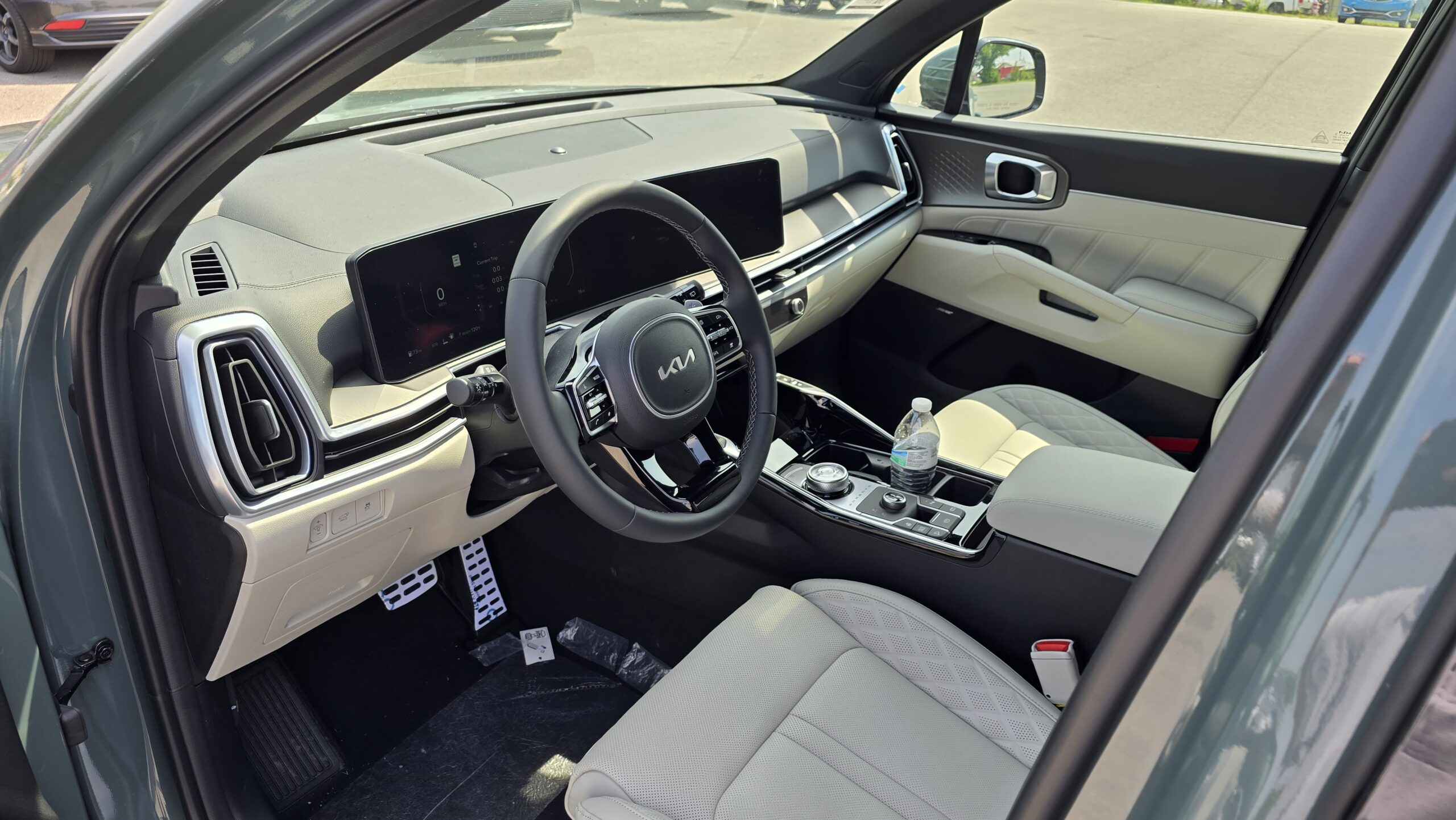
Approaching the vehicles, both have standard smart entry, remote start, and available phone-as-key. And opening the doors, you’ll immediately find the luxury and tech we’ve been hinting about.
That starts with the seats, where these top trims offer real leather seats with 14 ways of adjustment, heating and ventilation. But the Santa Fe has a higher-end grade Nappa Leather for its seats. Its driver seat also has the relaxation feature with an ottoman, perfect for road trip naps while parked.
Once inside, let’s talk about the major category of material quality, which we divide into both solidity and material selection. While their build quality is top-notch on each, the Santa Fe retains a materials advantage. Both feature plenty of soft-touch materials throughout, but the Hyundai doesn’t use piano black on its center console, a potential scratch and fingerprint magnet in the Sorento.
After startup, you’ll be greeted by customizable 12.3-inch digital gauge clusters, with the convenient blind spot camera system inside. However, it’s only the Santa Fe that will have a Head-up Display to keep your eyes on the road.
Back to the steering wheels, they’ll be heated and leather-wrapped, as well as flanked by rain-sensing wipers for the top models.
Storage and Technology
Our next twofold category is interior storage, with the center console and additional storage cubbies. While the Sorento is by no means impractical, Hyundai really went all out with the Santa Fe. The center console can store 24 donuts, the maximum score, vs. 17 in the Kia. It also has deep cupholders, a huge center pass-through, and even two passenger storage shelves. Santa Fe undoubtedly takes the points here.
But, the Hyundai isn’t done yet… it has an additional wireless phone charger to keep your co-pilot fully charged!
Okay, enough on storage! Let’s flip… or rotate the electronic shifters into reverse, where both have 360-degree cameras with the 3D spin feature.
Moving up the dash, you’ll find physical knobs for the dual zone climate controls. But the Sorento’s also double as media controls as well, which we find trickier to use on the day-to-day.
Speaking of, let’s put it into audio mode and turn the volume knob to compare the audio systems. These two have identical 12-speaker Bose sound systems, so they have the same quality, as expected.
Both: 12-speaker Bose audio systems
And that brings us to the infotainment systems, where both are pretty identical, but that’s a good thing! They have 12.3-inch displays with the latest ccNC software, which is very responsive. We have wireless ACP and AA and navigation on board as well!
Finally, up top, both have an auto-dimming mirrors with digital camera ability. And, while shaped differently, they also have dual-pane panoramic moonroofs with premium suede headliners.
LOOKING TO BUY One OF THEse VEHICLES?
A smart next step would be to check our Car Quote Tool. This tool will connect you with local dealerships in your area to get you the BEST price, access to INVOICE PRICING information, and a monthly payment calculator. Get dealerships to compete for your business!
Rear Seats and Cargo
Now, it’s time to dig into the equally important back seats and cargo areas. Starting with the 2nd row measurements, they are very similar, as you’d expect for models with the same basic underpinnings. Santa Fe technically has the advantage, but by less than the 5% difference required to score a point.
Santa Fe: Legroom: 42.3-inches | Headroom: 40.6-inches
Sorento: Legroom: 41.7-in | Headroom: 39.1-inches
While space is similar, each has a unique set of features offered. Both have heated captain’s chairs, vents, USBs, and sunshades for the top trims. But only the Sorento has a console-mounted 12V outlet and household outlet.
Meanwhile, the Santa Fe replaces said outlets with a dual-opening console lid and rear-facing drawer to improve upon the functionality. Most notably, the Hyundai’s captain’s chairs are power adjusting, which means they can be adjusted more easily than the Kia can. Nonetheless, your rear passengers will be spoiled in both models!
Furthermore, both have 2 more seats located in the standard third rows. While not superior to their larger Palisade and Telluride siblings, these third rows are better than you’d expect for the money. They are best for kids, but adults can fit back here, and the official measures are within a 5% difference of each other. If you have taller passengers, note the extra headroom in the Santa Fe.
- Santa Fe: Legroom: 29.9-in | Headroom: 37.7-in
- Sorento: Legroom: 29.6-in | Headroom: 36.8-in
Both have third row vents, power connections, and cupholders, but only the Hyundai has a knob to adjust the climate.
Heading out back, both have smart opening tailgates, and once they open, the boxy shape of the Hyundai really starts to show its strength. It has 14.7% more cargo volume with the third row in place, although as the seats fold down, the advantage shrinks to just over 5% behind the second row and as a maximum behind the first row.
Santa Fe: 14.6 cubic feet behind 3rd row | 40.5 cubic feet behind 2nd row | 79.6 cubic feet max
Sorento: 12.6 cubic feet behind 3rd row | 38.5 cubic feet behind 2nd row | 75.5 MAX cubic feet
Both models have manual folding third row seats and power releases for the second rows. But, as equipped today, only the Sorento offers a spare tire, while the Santa Fe only has a mobility kit.
Alrighty, so that it for the interiors, but now let’s take this fight to the streets!
Powertrains
While most things you can see are quite different between these two models, what you cannot see is much more similar. That starts with the basic platforms and continues to the several powertrains, where today, both have Hyundai and Kia’s latest hybrid system. This is a 1.6L Turbo I-4 with hybrid-electric componentry. The Santa Fe has slightly more power and torque than the Sorento, but acceleration between the two is almost identical.
Sorento: 1.6L Turbo I-4+ elec: 227 hp | 258 lb.ft
Santa Fe: 1.6L Turbo I-4 + elec: 231 hp | 271 lb ft
Both crossovers have AWD systems, as equipped, and the hybrid systems work with traditional 6-speed automatic transmissions. While sometimes slow shifting, these transmissions avoid the droning sound that many rivals CVT’s produce.
Test Drive and Fuel Economy
When it comes to dynamics and ride quality, both left us impressed. But, between the two, the Sorento is going to have the somewhat sportier feel. It is tuned to be a bit firmer, and as such, it has less body roll around corners. Conversely, the Santa Fe will be softer-sprung and be more comfortable for highway cruising.
It’s also important to have serene environments free of loud noises, which is what we test with our signature Car Confections Sound Level Readings at 55 MPH. While both perform well here, the Sorento beats the Hyundai by more than 1 dB, which is considered a noticeable amount to the average adult.
Sorento: 54.3 dB @ 55 MPH
Santa Fe: 55.8 dB @ 55 MPH
And finally, for fuel economy, the Hybrid variants certainly help improve the efficiency of these family SUVs, with almost identical ratings. Both also have available gas models, but only Sorento offers a Plug-in Hybrid variant in the US.
Santa Fe AWD: 35/34/34 MPG
Sorento AWD: 32/35/34 MPG
Resale & Reliability
In our reviews and comparisons, we are also adding in reliability and resale information to give you a better picture of the overall value beyond just the original MSRP.
Beginning with reliability, we developed the Combined Reliability Index, which takes into account several studies from trustworthy sources, and combines them in a way that gives a more realistic picture. For the past few years, Kia has consistently outperformed its corporate sibling here, ranking 6 slots above the overall industry average. Meanwhile, Hyundai is 2 slots below the industry average.
However, they share the same industry-leading long warranty coverage, with neither including complimentary maintenance for 2026.
We also put Mason’s economics degree to work to develop a detailed Predicted Resale Value tool. After 5 years and 60,000 miles, the opposite is true here, with Hyundai outperforming Kia. Its expected resale value is 55.4% of MSRP after 5 years, while Kia comes in at 49.0%.
And if you’d like to check out all our data about reliability and resale values, as well as learn about our methodology, make sure to head to carconfections.com/resale and /reliability. Buying a car is a big decision, and this is a great place to compare all the makes you might be cross-shopping.
Price Assessment
So, after all is said and done… how do these jampacked offerings deliver on value? While both deliver surprising value around the $50,000 price point, the Kia is the less expensive of the two. Considering many of the features these two offer are exclusive within this segment, most buyers will be pleased with the overall packaging on each.
Keep in mind there is a $3,215 price difference between these two siblings.
MSRP (Calligraphy HEV AWD): $50,250 | Options: $0 | Destination: $1,600 | Total: $51,850
MSRP (SX-Prestige HEV AWD): $47,190 | Options: $0 | Destination: $1,445 | Total: $48,635
2026 Hyundai Santa Fe vs. Kia Sorento Winner!
Well, there’s our objective winner! Do you agree? Let’s summarize to figure out which one should be your personal winner.
Santa Fe:
- More features throughout
- More cargo capacity
- Rear Seat comfort and ride quality
Sorento:
- Additional fog lamp visibility
- Better estimated reliability
- Less Expensive
Now we want to know your opinions, so make sure to head to the comment section and let us know which one you would pick!
Thanks for joining us for another Car Confections Comparison! We’ll catch you next time as we sample the latest automotive delicacies!








Recent Comments